Masterclass summary
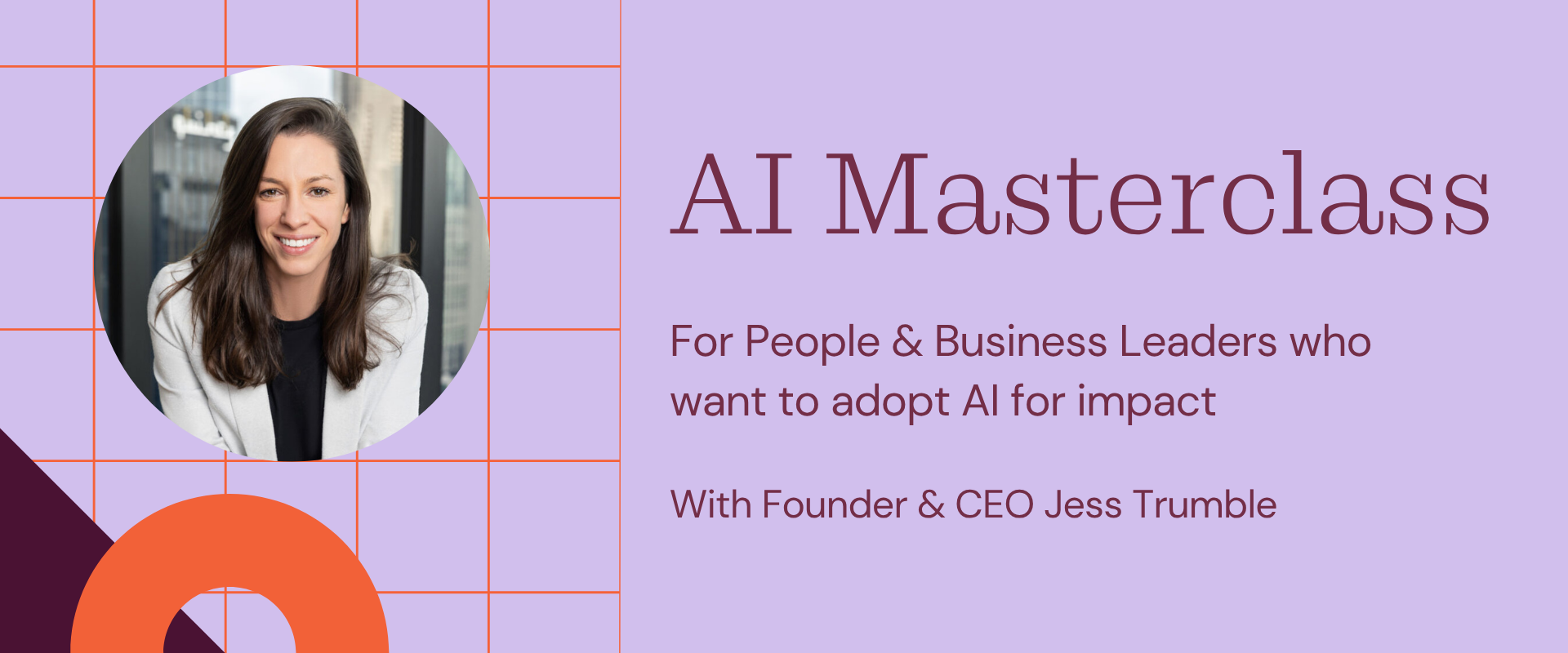

We recently hosted an online AI at Work Masterclass. Led by our founder and CEO, Jessica Trumble, the premise was simple: research shows that 95% of strategic AI projects fail to deliver their intended value, so what can organisations do differently?
Jess shared the importance of reframing AI integration from a technology project to a people-led capability and behavioural transformation. Here are the key themes and practical strategies from the session.
1. A people transformation, not a technology project
AI has been around for longer than many people realise, but the bridge between the average person and accessibility to technology has closed dramatically over the last 24 months. That's exactly why AI projects are failing. Businesses are approaching it as a technology-based transformation, when it's actually a behaviour and capability shift.
Technology is just the enabler. AI tools are still largely reliant on people to use, deploy, train and evolve them. Therefore, we need to see people as the primary connector of AI capability to commercial outcomes, in order to realise the benefits it offers.
Right now, we're in the era of AI slop. Without proper upskilling and human oversight, businesses risk a performance downturn, increased errors and negative sentiment before AI-based projects even get off the ground. This is why AI transformation needs to be people-led. People teams shouldn’t just be supporting the shift, they should be driving it.
2. Focus on the work
The starting point for AI transformation isn't your workforce, your org chart or the roles across your business. It's the work. That means drilling down to the task and activity level, considering what people are doing day-to-day, and thinking about how that could be delivered differently.
- Map the work: Undertake an activity analysis using position descriptions, skills libraries and leader input to build an organisation-wide view of activities.
- Categorise it: Define activities as strategic or transactional, high-value or low-value, high criticality or low.
- Cost it: How many people are doing each activity? What does it cost? Where is there duplication?
- Reimagine it: If certain tasks shifted to agentic or automated delivery, what could those people do instead?
The shift isn't about removing people. It's about moving them to higher-value work. Frame it commercially for your CEO and CFO showing: here is where we spend money today, here are the opportunities, and here is the intended benefit realisation.
"The starting point for AI transformation isn’t your workforce. It’s the work."
3. Strategic frameworks guiding strong foundations
An organisation-wide activity analysis will surface a huge number of opportunities, and that can quickly feel overwhelming. Before you tackle everything at once, sharpen your focus.
Start with three questions:
- What should AI do for us? Consider highly manual repetitive tasks where automation would improve outcomes.
- What can AI make us better at? This often leads to a hybrid model where AI assists human analysis, prediction and decision-making, but people maintain oversight and control of the output.
- What should AI not do? For example, tasks requiring uniquely human traits such as nuance, empathy, relational judgment and high-level creative thinking.
💡 Tip: Start with tasks that are high-volume, low-to-medium complexity, frequent, have accessible data, and carry a low-regret risk if something goes wrong.
4. Dual deployment model
When every initiative feeds through one central team, the bottleneck will choke your pace of innovation. AI deployment needs to happen at two speeds:
- Enterprise priorities: highly skilled workers focused on reimagining value delivery and how your business serves customers.
- Grassroots development: enabling the broader organisation to build, test and deploy agents for everyday productivity gains.
Focusing on productivity is not the end game. Productivity needs to come through grassroots development. Enterprise priorities should focus on redesigning the value exchange between your business and customers, making you stand out in the market.
5. Redesigning work systems
Setting ambition is one thing. Realising it requires People teams to rethink the core work systems that sit around their workforce. This is where People & Culture has the greatest opportunity to attach work to the future-of-work ambition.
Position descriptions: Continuous improvement, innovation, and technology adoption need to become core expectations for every role. There won't be much tolerance for manual, inefficient processes or a mindset of "we've always done it this way”.
Performance and accountability: High performance needs to become the norm, not the aspiration. With the tooling and enablement now available, the bar for what a high-value exchange looks like in every role is going to keep rising.
Recognition and reward: Curiosity, adaptability, initiative and resilience need to be the behaviours you recognise and reinforce. Celebrate the person who automates part of their role and proposes what they could do instead.
Learning and development: There is a whole new set of skills to build. On the technical side: prompt engineering, agent building, orchestration and for some roles, basic scripting. But the new-age soft skills (discernment, critical thinking, communication quality and human judgment) are what will differentiate people going forward.
Measurement: Establish your baseline before you start: time spent, cost, quality of output. Track impact as you iterate: cost reduction, speed, accuracy, employee and customer sentiment.
💡 Tip: Keep measurement simple, but don't skip it. This data builds the case for bigger programs and strengthens credibility with the stakeholders.
"It has never been easier to get an ambitious People program signed off if you approach it with a commercial lens."
6. What's on the other side
None of this is a small task. Performance bars are lifting, roles are shifting and the pace of change can feel relentless. There is a messy middle ahead and People teams are sitting at the coalface of it.
But the opportunity on the other side is significant. We have the chance to connect employees to higher-purpose work, to personalise the employee experience in ways that drive genuine performance and satisfaction, and to build skills that make people more mobile and flexible than we've ever seen.
Don't spend too much time trying to figure out the future. Instead, start reimagining the now. If you can rebuild your work models and structures to be fluid, iterative and able to evolve, you're setting up your organisation to move with the future of work.
We hope you found this article useful. If you’d like to listen to the full session, you can find the recording here:
And if you’d like to discuss AI strategy and implementation, please don’t hesitate to reach out and book a time with Jess.
More articles & resources
.avif)


Board table to lunch table. We're here to listen.
Every good relationship starts with a conversation, so let's begin there. Please get in touch if you'd like to discuss your People & Culture needs.